Have you ever been told that in order to be truly saved, you have to “turn from your sins”? It sounds incredibly pious, holy, and right. But if we put our emotions aside and look strictly at what the Bible actually says, we run into a massive, shocking truth: Requiring someone to turn from their sins to get or keep salvation completely destroys the gospel of grace.
If you are tired of the performance trap, jumping through religious hoops, or constantly fearing you might lose your salvation, this post is for you. Let’s look at the hard biblical proof for why turning from sin is a work, why it cannot save you, and why you are locked in God’s hands forever once you believe.
1. The Shocking Proof: God Labels “Turning From Sin” As a Work
Most people assume that “works” only mean things like giving to charity, getting baptized, or keeping the Ten Commandments. But the Bible gives us a very explicit, airtight definition of what turning from sin actually is.
Look at Jonah 3:10:
“And God saw their works, that they turned from their evil way; and God repented of the evil, that he had said that he would do unto them; and he did it not.”
When the people of Nineveh changed their behavior and abandoned their sins, God didn’t call it “heartfelt surrender” or “true repentance.” He explicitly labeled it as “their works.”
Turning from sin requires human effort, willpower, a change in behavior, and a reformation of conduct. Because it is an action performed by man, it falls squarely under the category of works.
2. The Dangerous Math of Mixing Grace and Works
Why does it matter if turning from sin is a work? Because the Apostle Paul outlines a strict mathematical incompatibility between grace (unmerited favor) and works (human effort). They cannot mix.
Romans 11:6 states:
“And if by grace, then is it no more of works: otherwise grace is no more grace. But if it be of works, then is it no more grace; otherwise work is no more work.”
If salvation is a free gift, it must be 100% free. The moment a preacher tells you that you must promise to stop sinning to be granted eternal life, salvation ceases to be a gift—it becomes a conditional reward based on your performance. It nullifies grace entirely.
The Real Meaning of Repentance (Metanoia)
But wait, doesn’t the New Testament tell us to repent? Yes! But the original Greek word used is metanoia, which literally means “a change of mind.”
In the context of salvation, biblically repenting means changing your mind from trusting in your own self-righteousness, your religion, or your ability to be a good person, and shifting your trust entirely to the finished work of Jesus Christ. It is a change of mind from unbelief to belief.
3. The Blueprint of Ephesians 2:8–10
A favorite counter-argument to this is Ephesians 2:10, which says we are “created in Christ Jesus unto good works.” People use this to say, “See? If you don’t have works, you aren’t saved!”
But let’s look at the exact timeline Paul lays out in Ephesians 2:8-10:
- The Root (Verses 8-9): “For by grace are ye saved through faith; and that not of yourselves: it is the gift of God: Not of works, lest any man should boast.” This is how you get into Christ. It is a free gift, totally detached from your behavior.
- The Fruit (Verse 10): “For we are his workmanship, created in Christ Jesus unto good works, which God hath before ordained that we should walk in them.”
Notice the preposition: we are saved unto good works, not by them. Good works and turning from sin are the result of maturing in the faith, IF one chooses to do so.
Furthermore, Paul says we should walk in them, not that we guaranteed will without exception. We still have a fleshly nature, and Christians can stumble. If walking in good works perfectly were required to prove or maintain salvation, salvation would ultimately depend on human endurance, directly contradicting verses 8 and 9.
4. Can You “Walk Away” and Break the Seal?
What about the crowd that claims, “Okay, salvation is a free gift, but you still have the free will to walk away from God and lose it”?
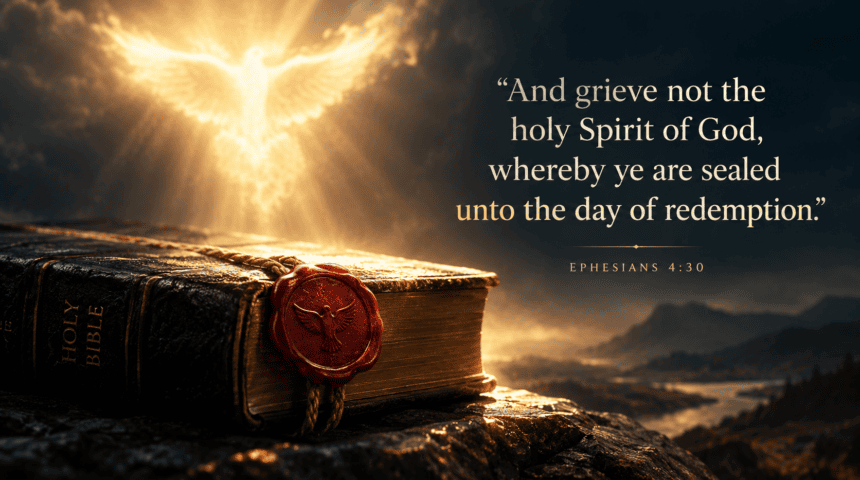
This idea completely falls apart when you look at the absolute security of the Holy Spirit’s seal. Ephesians 4:30 commands:
“And grieve not the holy Spirit of God, whereby ye are sealed unto the day of redemption.”
In the ancient world, a king’s seal represented ownership, authority, and unbreakable security. When you trust Christ, God places His Holy Spirit inside you as a royal seal.
- Note the expiration date: “unto the day of redemption” (the final resurrection of our bodies).
- God does not say you are sealed until you change your mind or until you walk away. It is a permanent status locked in by God. To “walk away” and lose your salvation, you would have to be stronger than God and break His seal.
Why Free Will Doesn’t Allow You to “Un-Born” Yourself
Does this override human free will? Absolutely not. Free will allows you to make a choice, but it does not allow you to undo the cosmic reality of that choice once it is made.
Think of it as spiritual DNA. John 1:12 says that when we believe, we are born into God’s family. Salvation is a re-birth (John 3:3). If an earthly child throws a tantrum, disowns their parents, and walks away from home, they have broken fellowship, but they cannot un-child themselves. Their DNA remains identical. You used your free will to be born again; you cannot use your free will to be “un-born.”
5. The Ultimate Question: “Believest Thou This?”
At the end of the day, eternal security isn’t about how well you perform or how hard you try to stay on the path. It rests entirely on the simplicity of a promise made by Jesus Christ. In John 11:25-26, Jesus makes the ultimate declaration of life:
“Jesus said unto her, I am the resurrection, and the life: he that believeth in me, though he were dead, yet shall he live: And whosoever liveth and believeth in me shall never die…”
And then, He cuts right through all the theological debates, the religious arguments, and the human traditions with one incredibly simple, direct question:
“…Believest thou this?“
Notice Jesus didn’t ask Martha if she promised to turn from every sin, get water baptized, or join a local church. He asked if she believed the promise. If you believe it, you have everlasting life and you will never die. It really is that simple.
So, let me ask you right now, as you read this: Well, do you?
The Bottom Line
When a believer rebels, they don’t lose their salvation—they grieve the Holy Spirit (Ephesians 4:30). Because they are God’s children, God will activate loving, divine discipline on earth to correct them (Hebrews 12:6). In extreme cases of rebellion, He might even take them home early via physical death (1 Corinthians 11:30)—but their soul remains 100% secure.
Salvation is a done deal. Stop trying to earn what has already been paid for, and start resting in the secure, unbreakable promise of Jesus Christ!


